Your hotel’s website and online travel agency (OTA) profiles each play a distinct role in turning online visitors into guests. Think of your website as your digital lobby, an inviting space that reflects your brand, exhibits your property, and inspires confidence to book directly. From stunning professional photography to real-time availability and exclusive offers, it provides guests with everything they need to make an informed decision. It’s also the one online space you fully own and control, allowing you to present your hotel exactly as you want it to be experienced.
By contrast, OTA profiles function like a digital billboard, broadly showcasing your property on major booking platforms such as Expedia and Booking.com. They’re designed to capture attention and spark interest, inviting guests to learn more. While the information displayed in your OTA listings is more streamlined than what appears on your website, it plays a vital role in driving reach and visibility. However, because OTAs maintain a standardized format, your ability to customize content and convey your unique brand identity is limited.
Let’s take a deeper dive into how your website and OTA profiles differ—and how you can strategically optimize each to maximize conversions.
Direct vs. Third-party Bookings
Your website empowers guests to book directly with you, bypassing costly commissions charged by online travel agencies, which can reach up to 30 percent. Direct bookings are inherently more profitable, allowing you to reinvest those savings into the guest experience. That’s why your most attractive promotions, packages, and exclusive offers should live on your own website.
Prominently display promotions and offers well before guests access your booking engine to capture their attention during the consideration stage. A dedicated “Special Offers” or “Packages” page provides a clear and engaging place for visitors to explore added value. You can also use a pop-up to highlight limited-time deals or exclusive perks; setting it to appear after a guest has spent about 30 seconds on a page ensures it feels helpful rather than intrusive.
Every page should provide a direct path to booking so guests can reserve the moment they’re ready. A prominently placed “Book Now” button in the header is a simple yet powerful way to meet this expectation.
While OTA bookings yield lower profit margins, they remain a valuable revenue stream, accounting for an estimated 40-50 percent of online reservations in established markets such as the USA and Europe. Strong direct marketing strategies reduce reliance on these third-party channels, but OTAs still play an important role increasing visibility and enabling travelers to compare multiple properties side by side.
To stay competitive, ensure your rates and availability are always accurate and consistent across OTA listings. A property management system (PMS) like WebRezPro simplifies this process by integrating with leading OTAs to automatically update inventory and pricing in real time.
Reach
Thanks to global brand recognition and substantial marketing reach, OTAs connect your property with a far broader audience than your website alone. That visibility is what makes participating in these platforms worthwhile, even when direct bookings are your ultimate goal. In essence, the commission you pay is an investment in exposure, attracting new guests who may not have discovered you otherwise.
Guest Data
Your website empowers you to collect valuable guest information at time of booking—such as contact details, preferences, and special requests that allow you to personalize each stay, target upsell opportunities, and build customer relationships. Third-party booking sites, on the other hand, limit access to this data, which makes your direct booking process even more essential.
Maximize the opportunity to get to know your guests with a website booking engine that captures the information most relevant to your property. Even better, choose one that supports customizable guest profile fields and integrated upselling—like WebRezPro.
Marketing Funnel Placement
While guests may book through both your website and OTA profiles, they typically visit your website later in the decision-making process. It’s common for travelers to begin their search on OTAs to compare multiple options and move to a hotel’s website once they’ve narrowed those down. In the 45 days before a booking, 80 percent of travelers visit at least one OTA, regardless of where they ultimately complete their reservation.
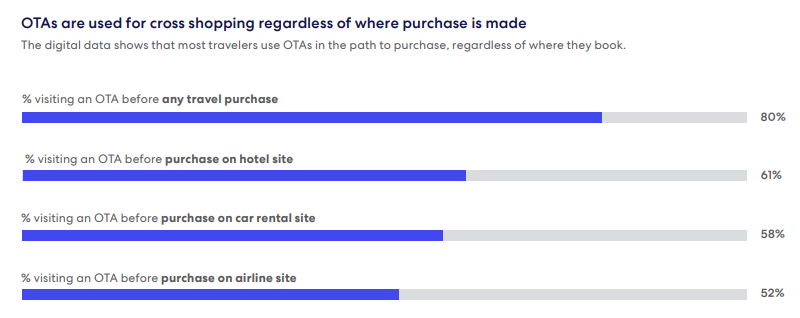
This underscores the importance of maintaining accurate, comprehensive OTA profiles. Counterintuitively, these listings often act as a vital touchpoint along the guest journey towards booking direct, driving awareness like a well-placed billboard. Before guests can book with you, they first need to find you!
Branding Control
Because your website is completely within your control, it offers endless opportunities to express brand identity, and it’s essential to make the most of them. Visually, invest in high-quality, professional photography that showcases both the interior and exterior of your property, capturing its unique appeal. Complement images with a cohesive color palette—typically a clean, neutral base paired with two accent colors. For a seamless guest experience, ensure that your booking engine mirrors your website’s look and feel, reinforcing professionalism and building trust.
Compelling written content is as important as stunning visuals. Your website provides the space to tell your property’s story, highlighting rooms, amenities, location, and experiences in greater depth than any third-party platform. Create a narrative that reflects your brand’s personality and resonates with your target audience. For example, a beachfront motel might adopt an informal, welcoming voice, while a luxury boutique hotel may lean toward a refined, sophisticated tone. Authentic, well-crafted copy not only informs, it inspires guests to book.
But while OTA profiles offer limited branding flexibility compared to your website, they still enable you to showcase your property and should not be overlooked. Take advantage of opportunities to add visuals by uploading the maximum number of photos allowed. All amenities should be accurately listed, as these serve as search filters and directly influence visibility. Additionally, make use of every text field provided—from descriptions to FAQs—to deliver clear, complete information. A thoroughly optimized profile enhances guest confidence and conversion potential.
Reviews
On your website, you can choose to feature guest feedback through an automated review widget or curated selection of testimonials. By contrast, OTA profiles automatically display verified guest reviews alongside an overall rating, an influential factor in travelers’ decision-making. In 72 percent of bookings, guests select hotels with higher review scores even when the price is greater.
This means proactive reputation management isn’t optional. Encourage guests to share feedback and monitor reviews across platforms to stay informed. You can leverage your PMS to streamline this process, automating review requests through customizable email templates that save staff time and ensure no guest falls through the cracks. WebRezPro simplifies this further with integrations to SMS messaging platforms like Akia, offering additional, convenient ways to connect with guests post-stay. And don’t underestimate the power of on-site reminders; displaying your preferred review platform in visible areas, such as near elevators or check-out stations, can gently prompt guests to share their experience.
Your website and OTA profiles serve distinct yet complementary purposes—your website acting as a digital lobby, and your OTA profiles as a billboard that draws guests in—but both are essential to online success. By investing time and effort to optimize each channel, you can enhance visibility, strengthen brand presence, and ultimately boost conversions.